Bienvenue à
Greensun Solar Energy, please call
+86 187 1510 8506
for help
 français
 English
 español
 العربية
1. Application aux systèmes de stockage d'énergie côté production
Du côté des générations centrale électrique de stockage d'énergieLe système de stockage d'énergie convertit l'énergie CC stockée dans les batteries en énergie CA via PCS, qui est ensuite connecté au bus principal de la centrale électrique ou directement au réseau via le tableau de distribution haute tension.
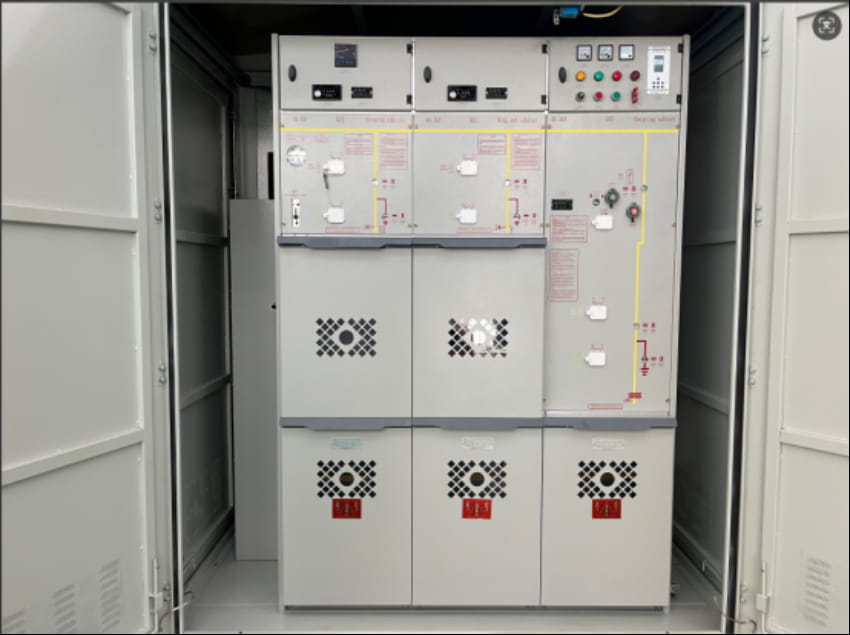
Les fonctions principales des appareillages de commutation haute tension comprennent :
(1) Contrôle du raccordement au réseau : Garantir la sécurité du raccordement et du débranchement entre le système de stockage d'énergie et le réseau électrique. réseau électriqueet en coopérant avec le PCS pour assurer une connexion et une déconnexion au réseau en douceur.
(2) Protection contre les défauts : Déconnexion rapide du circuit lorsque le système de stockage d'énergie ou le réseau électrique subit des défauts tels que des courts-circuits, des surcharges ou des surtensions.
(3) Distribution de puissance : Distribution de la puissance de sortie du système de stockage d'énergie au réseau électrique ou à la charge interne de la centrale électrique ; surveillance et mesure ; collecte de paramètres tels que le courant de connexion au réseau, la tension et la puissance du système de stockage d'énergie.
Le système de stockage d'énergie côté production possède une capacité importante, généralement de l'ordre de plusieurs centaines de mégawatts, et un niveau de tension de raccordement au réseau élevé, principalement de 10 kV à 35 kV. Par conséquent, l'appareillage haute tension doit présenter les caractéristiques suivantes : Pouvoir de coupure élevé : courant de coupure en court-circuit suffisant (généralement de 25 kA à 40 kA) pour supporter l'impact important du courant lors des courts-circuits dans les systèmes de stockage d'énergie de grande envergure ; Haute fiabilité : adaptabilité à l'environnement extérieur et aux cycles de fonctionnement prolongés des centrales électriques à énergies nouvelles, avec une résistance aux températures extrêmes, au vent, au sable et à l'humidité ; Intelligence : compatibilité avec le système de surveillance de la centrale et le système de gestion de l'énergie (EMS) pour permettre le contrôle à distance, le réglage automatique et la détection précoce des défauts.
2. Applications des systèmes de stockage d'énergie côté réseau
Le stockage d'énergie côté réseau est principalement utilisé pour lisser les pics de consommation et combler les creux de consommation, réguler la fréquence, soutenir la tension et assurer une alimentation de secours en cas d'urgence. Il s'agit d'un élément clé pour améliorer la flexibilité et la stabilité du réseau électrique, et on le trouve généralement dans les systèmes de stockage d'énergie rattachés à des sous-stations et dans les centrales de stockage d'énergie autonomes.
Les centrales de stockage d'énergie côté réseau sont généralement connectées directement au réseau de transport et de distribution d'électricité. L'appareillage haute tension, qui assure l'interface entre le système de stockage d'énergie et le réseau, prend en charge des tâches de contrôle et de protection plus complexes :
(1) Contrôle de l'écrêtement des pointes et du remplissage des vallées : En coordination avec les instructions de répartition du réseau, le système de stockage d'énergie se charge pendant les heures creuses et se décharge pendant les heures de pointe, passant rapidement d'un état de charge à un état de décharge via l'appareillage de commutation haute tension ;
(2) Régulation de la fréquence et de la tension : Lorsque la fréquence ou la tension du réseau fluctue, la puissance de sortie du système de stockage d'énergie est ajustée en coordination avec le PCS, maintenant la stabilité des paramètres du réseau grâce à la capacité de réponse rapide du poste de commutation haute tension ;
(3) Isolation des défauts : Lorsqu'un défaut survient dans le système de stockage d'énergie ou du côté du réseau, le tableau de distribution haute tension déconnecte rapidement le circuit de défaut pour empêcher le défaut de se propager à la ligne principale du réseau, assurant ainsi la sécurité globale du réseau ;
(4) Coordination de plusieurs sources d'énergie : Dans centrale électriqueDans les systèmes comportant plusieurs unités de stockage d'énergie fonctionnant en parallèle, le tableau de distribution haute tension permet un contrôle indépendant et un fonctionnement coordonné de chaque unité de stockage d'énergie, optimisant ainsi la distribution de l'énergie.
3. Applications des systèmes de stockage d'énergie côté utilisateur
Le stockage d'énergie côté utilisateur est principalement utilisé pour l'arbitrage des prix de l'électricité entre les pics et les creux de consommation, l'alimentation de secours et la gestion de la qualité de l'énergie. Il convient à des utilisateurs tels que les entreprises industrielles, les bâtiments commerciaux, les centres de données et les hôpitaux. Son niveau de tension de raccordement au réseau est généralement de 10 kV ou 0,4 kV (les appareillages haute tension sont principalement utilisés au niveau de 10 kV).
Les systèmes de stockage d'énergie côté utilisateur se connectent au réseau de distribution électrique interne de l'utilisateur via des appareillages de commutation haute tension, assurant ainsi une interaction bidirectionnelle avec le réseau électrique.
(1) Arbitrage pic-vallée : Pendant les périodes de bas prix de l'électricité, le système tire de l'énergie du réseau via l'appareillage de commutation haute tension pour charger le système, et la décharge pendant les heures de pointe pour l'usage propre de l'utilisateur, réduisant ainsi les coûts d'électricité ;
(2) Alimentation électrique de secours : Lorsque le réseau subit une panne de courant, le système passe rapidement en mode d'alimentation par stockage d'énergie via le tableau de distribution haute tension pour assurer le fonctionnement ininterrompu des charges critiques (telles que les serveurs de centres de données et les équipements médicaux hospitaliers) ;
(3) Gestion de la qualité de l'énergie : Pour traiter des problèmes tels que les fluctuations de tension et la pollution harmonique dans les locaux de l'utilisateur, le système fonctionne en conjonction avec le PCS et l'appareillage de commutation haute tension pour améliorer la qualité de l'énergie.



 Réseau IPv6 pris en charge